Product Description
| Brand |
Thermo Fisher Scientific |
| Product Type |
NGS KIt |
| Pack Size |
24 reactions |
| CAT No |
A53838 |
| Application |
Molecular Biology |
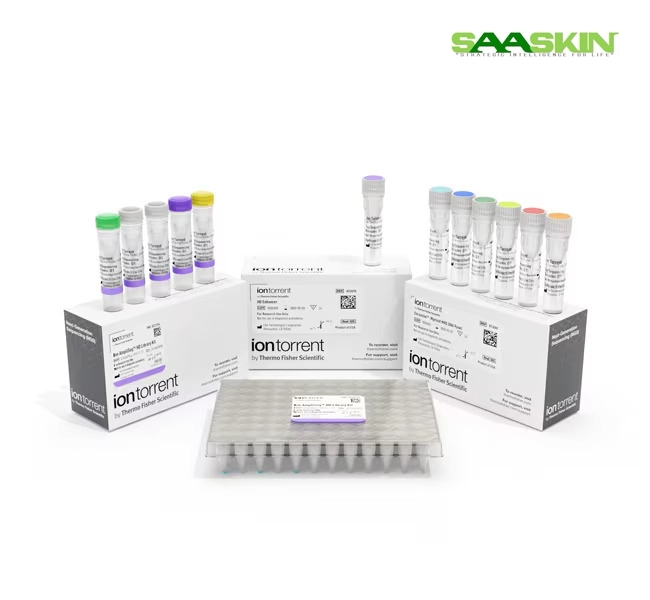
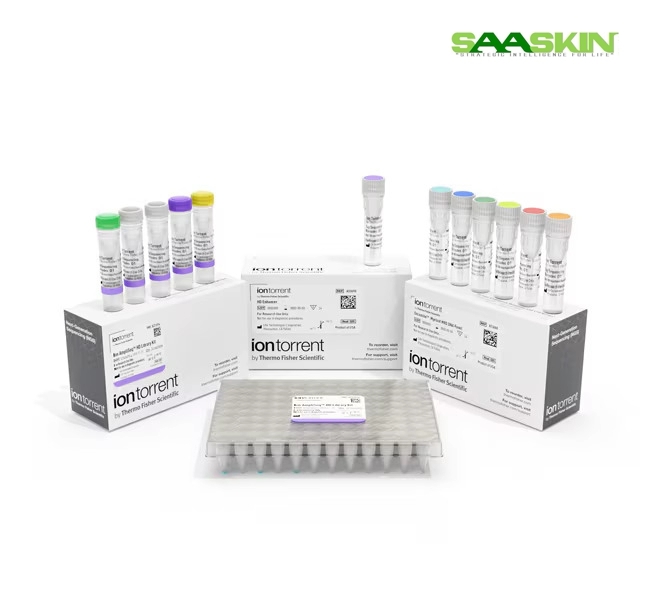
The Ion Torrent Oncomine Myeloid MRD DNA Assay (RUO) is a comprehensive targeted next-generation sequencing (NGS) assay designed for myeloid measurable residual disease (MRD) research. It is a DNA-only version of the Oncomine Myeloid MRD Assay (Cat. No. A53837). Ion AmpliSeq HD technology enables variant detection with sensitivity as low as 0.05% allele frequency.
Comprehensive Myeloid Mutation CoverageTargeting 42 genes commonly mutated in myeloid malignancies, the Oncomine Myeloid MRD DNA Assay supports thorough assessment of key somatic alterations. Genes such as FLT3, NPM1, DNMT3A, RUNX1, and TP53 are included, empowering users to monitor disease progression and therapy response across a wide array of myeloid disorders.
Streamlined, High-Sensitivity WorkflowThis assay leverages multiplex PCR and Ion Torrent NGS technology to detect variant alleles at low frequencies (down to 0.1% VAF, depending on workflow). A convenient library preparation protocol takes approximately five hours, and the system allows for simultaneous processing of up to 96 samples per run, maximizing efficiency in research laboratories.
Optimized for Research Use OnlyThe Oncomine Myeloid MRD DNA Assay is intended strictly for research use (RUO) and not for diagnostic applications. Its validated compatibility with blood, bone marrow, or cell line DNA supports flexible study designs, and integration with Oncomine analysis software streamlines result interpretation for researchers exploring MRD in myeloid cancers.
FAQ's of Thermo Fisher Scientific Ion Torrent Oncomine Myeloid MRD DNA Assay (RUO):
Q: How does the Oncomine Myeloid MRD DNA Assay detect measurable residual disease (MRD) in myeloid malignancies?
A: The assay utilizes multiplex PCR followed by amplicon-based next-generation sequencing, covering 42 myeloid-related genes. It accurately identifies and quantifies somatic variants at low variant allele frequencies (as low as 0.1%, depending on workflow), making it suitable for MRD assessment in research samples.
Q: What types of samples are compatible with this assay, and how much DNA input is required?
A: The assay is validated for DNA isolated from blood, bone marrow, or established cell lines. For optimal results, 10-20 ng of input DNA per reaction is recommended.
Q: Which sequencing instruments can be used with this assay?
A: It is specifically designed for use with Ion Torrent sequencing platforms, including the Ion S5, Ion GeneStudio S5, and Ion PGM systems. Compatibility ensures seamless integration into existing Ion Torrent-based laboratory workflows.
Q: When should researchers consider using this MRD assay kit?
A: Researchers should use this kit when investigating measurable residual disease, monitoring mutation dynamics, or exploring response to therapy in myeloid malignancies, strictly for research purposes, not diagnostic use.
Q: What steps are involved in the assay workflow, and how long does the process take?
A: The workflow includes multiplex PCR amplification of target genes, library preparation, sequencing on the Ion Torrent system, and data analysis using Oncomine software. Library preparation takes about five hours, with total run times varying depending on instrument and sample number.
Q: How does the assay benefit myeloid malignancy research efforts?
A: By enabling detection of low-level somatic variants across 42 relevant genes, the kit provides high sensitivity and throughput. This supports comprehensive MRD studies, therapy monitoring, and advanced insights into disease biology in myeloid malignancies.
Q: Where and how should the kit be stored for maximum stability?
A: The kit should be stored at 2-8C (refrigerated) as instructed on the manufacturer's packaging. Do not freeze the components. Typical shelf life is 6-12 months, though users should confirm with the packaging for exact expiration details.











 Accepts only Export inquiries




 Send Inquiry